








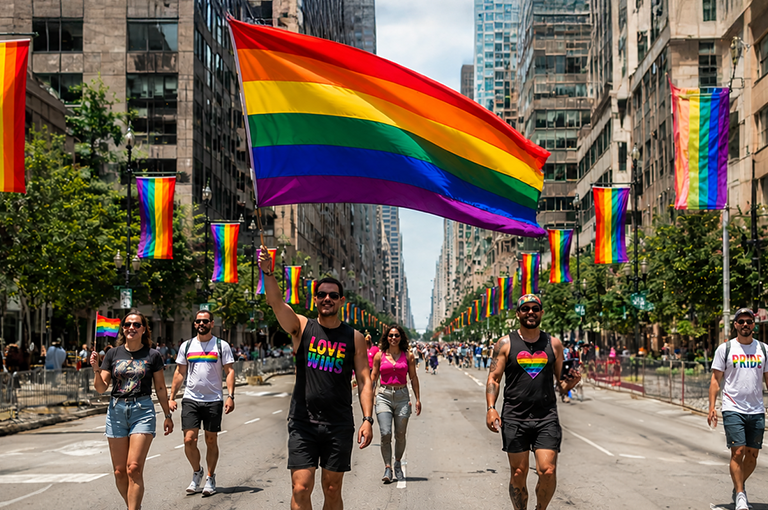

Walk through any Pride celebration today and you’ll see rainbow flags almost everywhere. They’re displayed on storefronts, carried through parades, hung in office lobbies, draped across community centers, and flown outside homes. The Pride flag has become so familiar that many people assume it has always existed.
In reality, the flag is less than fifty years old.
Its story begins in San Francisco during the late 1970s, at a time when the LGBTQ+ rights movement was growing in visibility and confidence. Activists were organizing, communities were finding their voices, and people were looking for a symbol that represented pride rather than persecution.
What emerged was a simple rainbow flag that would eventually become one of the most recognizable symbols in the world.
Before the Rainbow
Long before the Pride flag existed, the LGBTQ+ community often used the pink triangle as a symbol of identity and resistance. The symbol had originally been used by the Nazi regime to identify and persecute gay men during World War II. Decades later, activists reclaimed it as a statement of resilience.
While the pink triangle carried important historical significance, many felt it was still tied to a painful past. There was growing support for a symbol that focused on visibility, unity, and hope for the future.
That opportunity arrived in 1978.
Artist and activist Gilbert Baker were approached by Harvey Milk, one of the first openly gay elected officials in the United States. Milk encouraged Baker to create a symbol that could represent the LGBTQ+ community in a positive and empowering way.
Baker believed a flag was the perfect answer.
Unlike a logo or a slogan, a flag could be carried, displayed, and recognized from a distance. More importantly, flags have always represented identity. Countries have flags. Cities have flags. Movements have flags.
Why shouldn’t the LGBTQ+ community have one too?
The First Pride Flag Had Eight Colors

When people think of the Pride flag today, they usually picture six rainbow stripes. But that wasn’t the original design.
The first Pride flag featured eight colors, each with its own meaning:
- Hot Pink – Sex
- Red – Life
- Orange – Healing
- Yellow – Sunlight
- Green – Nature
- Turquoise – Magic and Art
- Indigo – Serenity
- Violet – Spirit
Creating the flag was not a commercial project. Volunteers gathered together to hand-dye fabric and sew the first flags themselves. Every stripe was intentionally chosen to represent a different aspect of human experience.
The original flags made their public debut during San Francisco’s Gay Freedom Day Parade on June 25, 1978.
At the time, nobody knew they were witnessing the beginning of a symbol that would eventually travel around the world.
A Design Changed by Practicality
The Pride flag that became famous wasn’t exactly the same as the one Baker originally created.
As demand for the rainbow flag banner increased, manufacturers faced a surprisingly simple problem: finding enough hot pink fabric.
The color was difficult to source in large quantities, making mass production challenging. As a result, the hot pink stripe was removed from future versions of the flag.
Not long afterward, organizers preparing Pride celebrations wanted a design that could be displayed evenly along city streets. To create a more symmetrical appearance, the turquoise stripe was removed, and indigo was replaced with a standard blue.
Those practical adjustments produced the six-color rainbow flag that most people recognize today:
- Red
- Orange
- Yellow
- Green
- Blue
- Violet
What’s interesting is that these changes weren’t made for political reasons or because the meanings had changed. They happened because of manufacturing and display requirements.
Yet that simplified version became the design that spread globally.
The Rainbow Goes Worldwide
Throughout the 1980s and 1990s, the Pride flag appeared at more events, marches, and celebrations each year.
As LGBTQ+ communities gained visibility in different countries, the rainbow flag traveled with them. It became a symbol that crossed borders, languages, and cultures.
People didn’t need to speak the same language to understand what the flag represented.
For many, it symbolized acceptance.
For others, it represented courage.
For some, it was simply a sign that they weren’t alone.
By the 1990s, the Pride flag had become a globally recognized emblem of LGBTQ+ identity. One of the most memorable moments came in 1994, when Gilbert Baker created a mile-long rainbow flag to mark the 25th anniversary of the Stonewall uprising.
The flag was no longer just a symbol of a local movement.
It had become an international one.
Why New Pride Flags Started Appearing

As conversations around inclusion continued to evolve, people began asking an important question:
Could the Pride flag do more to represent the diversity within the LGBTQ+ community itself?
In 2017, the Philadelphia Pride Flag introduced black and brown stripes to highlight LGBTQ+ people of color and acknowledge conversations about racial equality within the community.
The following year, designer Daniel Quasar introduced the Progress Pride Flag.
Rather than replacing the rainbow, the design was built upon it. A chevron shape was added to one side of the flag featuring:
- Black and brown stripes
- Pink, light blue, and white stripes representing the transgender community
The arrow-like design intentionally points forward, symbolizing ongoing progress while recognizing that work still remains.
In 2021, another update added the yellow and purple circle from the intersex flag, creating what is now known as the Intersex-Inclusive Progress Pride Flag.
These newer designs demonstrate something important about Pride symbols: they continue to evolve alongside the communities they represent.
More Than a Flag
One reason the Pride flag has endured for decades is because it serves multiple purposes at once.
It’s a symbol of identity.
It’s a symbol of celebration.
It’s a symbol of solidarity.
And sometimes, it’s simply a visible reminder that people belong.
Today, Pride flags appear in places that would have been difficult to imagine when Gilbert Baker first stitched together the original design in 1978. Schools display them. Businesses fly them. Cities incorporate them into public celebrations. Community organizations use them to create welcoming spaces.
The rainbow has become part of everyday life for millions of people.
Pride Flags in Modern Celebrations

Pride Month remains one of the most visible times for Pride flags, but their use extends well beyond June.
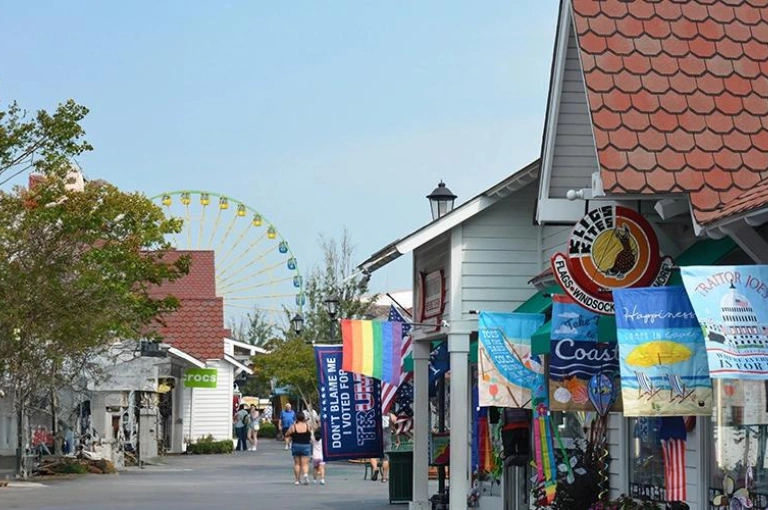
Community festivals, charity events, workplace initiatives, awareness campaigns, and local celebrations often incorporate Pride-themed displays. Flags, banners, event signage, window graphics, and branded displays all help create a visual sense of inclusion and celebration.
Many businesses also participate by displaying Pride-themed branding during community events and local Pride celebrations. Custom flags have become a popular way to support these initiatives because they are easy to display both indoors and outdoors.
At BannerBuzz, businesses, organizations, and event planners often create custom Pride flags and event displays featuring rainbow colors, company branding, community messages, or event-specific artwork for Pride Month celebrations and year-round inclusion initiatives.
A Symbol Still Growing
The history of the Pride flag isn’t a finished story.
What began as a hand-sewn banner in San Francisco continues to evolve nearly five decades later. New designs, new conversations, and new generations continue to shape what the flag represents.
Yet despite the changes, its core purpose remains remarkably consistent.
The Pride flag was created to celebrate visibility, diversity, and community.
Today, whether it’s the original rainbow design, the Progress Pride Flag, or one of the many identity-specific flags seen at Pride events around the world, that message continues to resonate.
A simple rainbow became a global symbol, not because of the fabric it was made from, but because of the people who saw themselves reflected in its colors.